
KINTSUGI
When was the last time you broke a dish, a serving platter, or a bowl? Did you toss it? Glue it? Kintsugi it?
“What is Kintsugi?” you may ask.
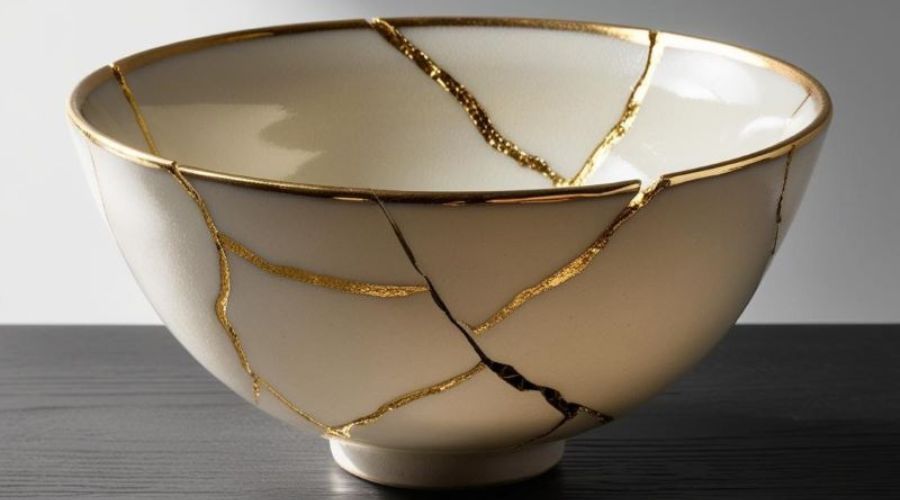
Kintsugi is a fifteenth-century practice that means “to join with gold.” A Kintsugi artist fixes broken pottery by mending the breaks with urushi lacquer dusted or mixed with powdered gold. Out of the broken pieces come works of beauty as the artist embraces the beauty found in imperfection.
(For more on this topic, read my article, Broken Dreams, Fulfilled)
Facial Imperfections
 Look at a face closely. Are both sides exactly the same? According to most research, only about 2% of the population has facial features close enough to be considered symmetrical. If you cover one-half of a photograph, then the other, you may see tiny differences, or “imperfections.”
- A raised lip on one side.
- An eyebrow higher than the other.
- Eyes that are not placed at exactly the same level.
If you look closely at my picture, you’ll see that one eyebrow is high sooner than the other; one eye is open wider than the other; and while one side of my mouth lifts up, the other side droops down a bit.
Our Desire for Perfection
How often do we feel we need to be perfect, do everything well, and excel in all our tasks? I often say I’m a recovering perfectionist. I’ve grown to accept more of my shortcomings even while I try to improve them.
The other night, I drove home in the dark and wanted to move to the right lane. I checked for the little lit cars in my side mirrors—none. I glanced to my right and saw nothing. Suddenly, Don said, “Carol, stop!”
There was a black car right next to me. I didn’t see it. Much further and I would have collided with that vehicle.
Then I looked down and the little light that shows cars in my blind spot was turned off! Yikes! I felt bad enough about this near miss, but also thanked both Don and God for watching over me. I know I’m far from perfect in many areas, and yet both love me.
A Perfect Love
Jesus loved me enough to die on a cruel, rough tree, a crown of thorns digging into his head. Enough to take the penalty for my sin so I could be free of condemnation and judgment. He lived the life I couldn’t live, and died the death I should have died.
That’s where Kintsugi comes in. God takes the broken pieces of our lives and fills them with Himself.
And yes, we still blow it. We still have near accidents (or at times, severe accidents). We sin. We become catty. And yet, if we allow Him to, God takes those imperfections and creates out of them something beautiful in us.
Not as If the Imperfection Never Happened
Pastor Rene Schlaepfer introduced this concept to us a few weeks ago. My favorite slide was this one.
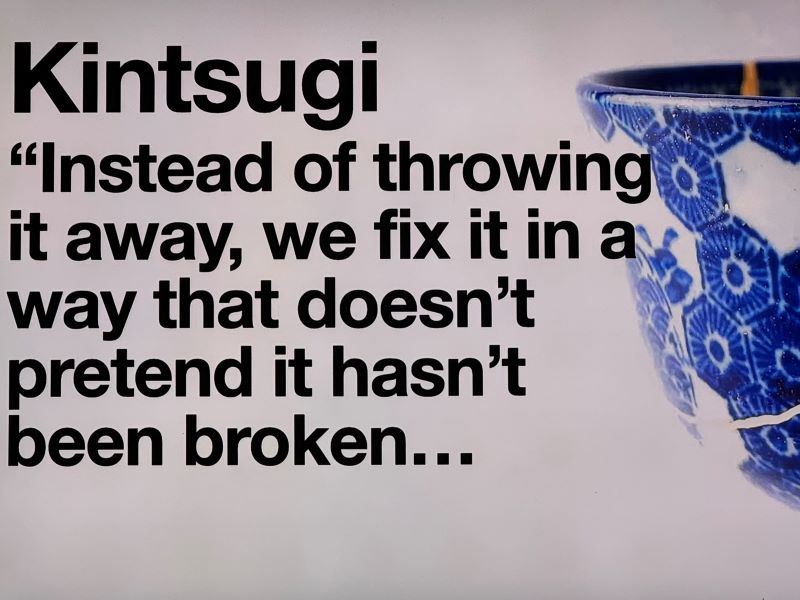
“…we fix it in a way that doesn’t pretend it hasn’t been broken.”
Wow. How often do we feel we need to hide our brokenness from others?
But he said to me, “My grace is sufficient for you, for my power is made perfect in weakness.” Therefore I will boast all the more gladly about my weaknesses, so that Christ’s power may rest on me. That is why, for Christ’s sake, I delight in weaknesses, in insults, in hardships, in persecutions, in difficulties. For when I am weak, then I am strong.
—II Corinthians 12:9-10
In our Weakness, God shows Himself Strong
While wisdom is needed in sharing, it is in our weakness that God often shows Himself strong. He has also promised that, as we are comforted by God in our troubles and weaknesses, we can also comfort others.
Blessed be the God and Father of our Lord Jesus Christ, the Father of mercies and God of all comfort, who comforts us in all our affliction, so that we may be able to comfort those who are in any affliction, with the comfort with which we ourselves are comforted by God.
—II Corinthians 1:3-4
God desires to do His Kintsugi work in us, to bring us toward wholeness as we look to Him in repentance and faith, allowing Him to use our broken pieces to create lives of beauty that reflect His light.
(Reference: Kintsugi and the Power of Redemption, by Gregory J. Miller, Malone University)
I love this post. “…we fix it in a way that doesn’t pretend it hasn’t been broken.” Jesus had done that for us! He uses our brokenness to draw us to himself and give us a story to tell. Thanks for the beautiful message!
Thank you Ruth! Yes, in our weakness, our brokenness, Christ is made strong. May we allow Him to show His grace to others through our brokenness.
Absolutely a beautiful devotion! We might be able to hide our brokenness from others, but never from our Healer.
Amen, Kathy! He is the one who sees, who knows, who heals! So thankful.